By Antonia Kaz
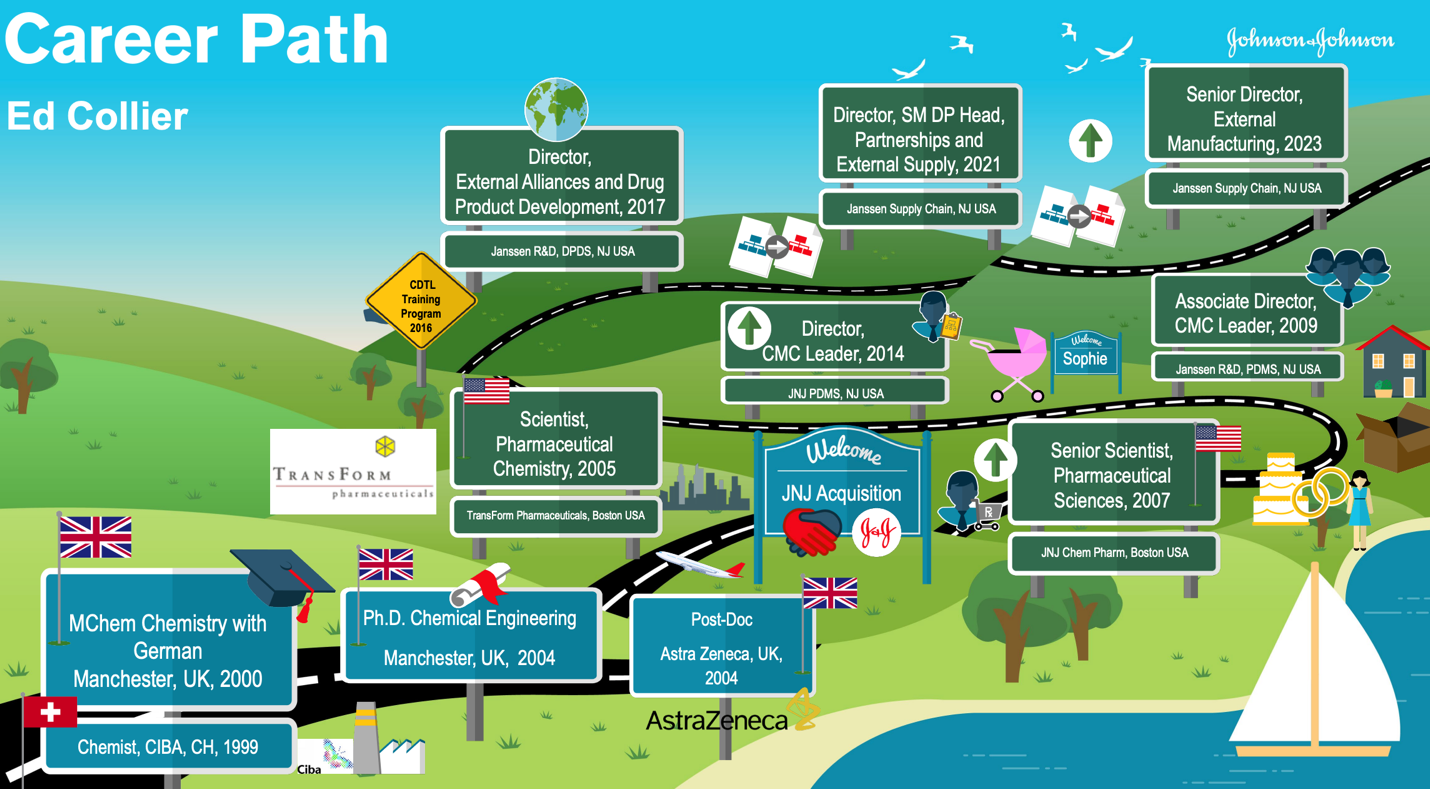
iJOBS events are often an opportunity to learn about new career paths and receive guidance from scientists in specialized industry roles. While other departments or university career offices often offer similar support, what makes iJOBS unique is the caliber of professionals it brings in. Dr. Edwin Collier, the presenter for the Supply Chain Careers in Pharmaseminar, was no exception. Approachable, honest, and eager to share insights from both his personal life and his professional journey, Dr. Collier walked us through the early-career decisions that eventually led him to a Senior Director role within Johnson & Johnson's (J&J) Innovative Medicine Supply Chain. This blog post highlights part of his story and the advice he shared as he navigated his career path.
As shown in the image above, Dr. Collier’s path to supply chain at J&J was far from linear. However, he built industry connections early in his academic career; opportunities that ultimately shaped his trajectory. His first industrial experience during his master’s degree opened his eyes to working abroad and pursuing a career outside of academia. This positive experience motivated him to pursue a PhD in Chemical Engineering that included a collaboration with AstraZeneca. During this collaboration, which later evolved into a post-doctoral role, he crystallized active pharmaceutical ingredients for early clinical studies. It was his first time applying classroom knowledge to real-world challenges, and he became so inspired that he even tried to convince his PI to start a company with him. Instead, his PI directed him to TransForm Pharmaceuticals, a company specializing in improving drug formulations and developing novel crystalline drug forms. Dr. Collier joined TransForm until it was acquired by J&J in 2005, marking the beginning of his long career at J&J.
Dr. Collier’s personal life played a significant role in his decision to stay at J&J after meeting his wife at TransForm pharmaceuticals. Not everything at J&J was smooth; he noted challenges when drugs came off-patent or after regulatory changes. However, there were a few key components to Dr. Collier’s success: 1) seeking opportunities to learn the business side of J&J, 2) networking and maintaining professional relationships, and 3) understanding how to climb the corporate ladder strategically. This last point was especially compelling—Dr. Collier explained that he often moved laterally before pursuing a promotion. While he seemed to have an end goal in mind, he first focused on developing the skills necessary to achieve it. Over time, he transitioned from R&D to supply chain by steadily accepting roles with increased responsibility.
In Dr. Collier’s words, “Supply chain organizationally is really about us getting the product out the door and understanding how we produce it and how we distribute it.” It involves logistics, planning, manufacturing, quality, regulatory, site managers, site teams, business leaders, and marketing. As an R&D specialist, he admitted that he did not really understand the complexity and importance of supply chain. He explained that, collectively, our understanding of the consequences of a disrupted supply chain was highlighted during the COVID pandemic. His appreciation for supply chain grew as he recognized how closely the field is connected to patient care. On difficult days, he often finds himself imagining a patient waiting for their medication. This motivates him and remains a source of pride.
As part of the seminar, Dr. Collier answered questions about his experience at J&J and within supply chain. His answers offered valuable insight for anyone considering the industry or supply chain roles.
Q1: How did you develop business acumen at J&J?
Dr. Collier explained how he was always curious about the business side of the pharmaceutical industry. He developed his business acumen primarily through on-the-job training, driven by his passion for learning. Dr. Collier also noted that J&J offers courses covering many aspects of the industry.
Q2: How should you get into the supply chain?
Dr. Collier emphasized that his path is just one of many. Some of his colleagues started from positions in supply chain, project management, logistics, etc. When applying for a supply chain job, he recommended highlighting qualities such as teamwork, leadership, drive, and problem-solving. Supply chains are only successful when every component within the chain works smoothly, so these traits are essential.
Q3: What can you do in grad school or as a postdoc to demonstrate your ability to collaborate?
The best candidates can clearly articulate their impact within a team and how they overcome obstacles. Dr. Collier encouraged students to identify three core skill sets that define them, practice delivering these skill sets, and tailor their message to each job opportunity.
Q4: Do you find that in supply chain, you are at the whim of the company to work outside of regular hours?
The work hours varies within J&J. Drawing on his experience managing work-life balance in more senior roles, Dr. Collier explained that supply chain is fast- paced, and it is easy to feel left behind even after a short period away. J&J tries to avoid overworking employees, but Dr. Collier encouraged job seekers to find a work-life balance and roles that align with their needs.
Q5: Would a mini-MBA help for a supply chain position?
Though he did not pursue a mini-MBA, Dr. Collier recommended taking advantage of any learning opportunity to expand your skill set and differentiate yourself from other candidates. This can be particularly useful for highly competitive positions such as project management.
On his final slide, Dr. Collier offered 10 “learnings and advice” for early career scientists:
- Stay sensitive to your work-life balance and recognize your line and limits. This will change as your life and priorities shift.
- Be deliberate about your mental and physical heath and always work on this as much as you do your career – love and appreciate yourself, and show gratitude towards others.
- Know what energizes and drains you, and do what you like and are good at – don’t force fit yourself into something you think you should do.
- Own your career but seek out help, mentors, sounding boards – consider 1-2 jobs out (how will your next role help you get the following one), think what this is adding to my resume, how do I explain the impact I had and what I delivered/learned? What skills can I transfer?
- Don’t title search, be willing to move laterally – do a great job, and the right/next one will come.
- But don’t stay in one role too long, and unless you really want to be an subject matter expert (SME) and if you do, we for sure need great SME’s more than ever!
- Learn how to prepare and present yourself to senior leaders/hiring managers - think ‘what is my brand’ and if I had to define myself in 3 bullet points – how do people/leaders see me and think of me - how do I want to be seen?
- Ensure that you have visibility to leaders, expand your network (meaningfully and deliberately), and get sponsorship and support.
- Be a complete team member, foster partnerships with others, and create joint goals (the ‘win-win’)
- You can be a leader at any level of an organization – feel empowered and just do it!
Dr. Collier’s story highlights that industry careers are rarely linear. For graduate students and postdocs exploring life beyond academia, his experiences remind us that success often comes from embracing new opportunities and building a diverse set of skills. Whether you’re considering supply chain or another industry pathway, Dr. Collier’s journey underscores the value of approaching your career with a willingness to grow.
This article was edited by Junior Editor Janaina Cruz Pereira and Senior Editor Joycelyn Radeny.