By Janaina Cruz Pereira
Recently, Rutgers iJOBS, in partnership with PMI NJ chapter, hosted a project management career panel, featuring Dr. Olajompo (Jompo) Moloye-Olabisi, PhD and Yung Chan as lead speakers. The seminar focused on using the five project management process groups: Initiating, Planning, Executing, Monitoring & Controlling, and Closing. A logical progression or framework to guide your career transition from Grad School to Industry. Dr. Moloye-Olabisi and Yung Chan discussed their experience making this transition and included considerations for joining a small or large company.
Dr. Moloye-Olabisi, the site lead at Johnson and Johnson Innovative Medicine and Supply Chain, started the seminar exploring her career path. Dr. Moloye-Olabisi holds a Ph.D. in Biomedical Engineering from the University of Florida, a Master's in Biomedical Engineering Biomaterials from the University of South Florida, and a Bachelor's in Chemical Engineering from Florida State University via the FAMU/FSU College of Engineering. She also holds a Mini-MBA in Supply Chain from Rutgers. She began her career at Johnson and Johnson in 2008 as a scientist in research & development at Ethicon (MedTech). In 2015, she strategically cross-functioned into the pharmaceutical sector, joining a development program that led her to the Supply Chain domain. Returning to Ethicon in 2017, Dr. Moloye-Olabisi started her supply chain journey as a principal engineer, supporting manufacturing engineering. She was then reassigned to return to Johnson and Johnson in 2021 for her current critical role.
Yung Chan, R&D Lab Manager at Applechem (Solabia Group), began her industry career path with Fast-Moving Consumer Goods ingredients industry. She holds an M.S. in Chemistry (UNC-Chapel Hill) and a Master of Business and Science in Chemical Engineering (Rutgers) which help her provide the technical and business insight essential for navigating complex product lifecycles. As their primary project coordinator, Chan routinely managed simultaneous initiatives, leveraging strong cross-functional team leadership to guarantee milestones are met. One of her big challenges is to balance the demands of experimentation, regulatory compliance, and collaboration to deliver innovative products, particularly in small-company environment where she wears many hats. With a robust educational background.
Chan and Dr. Moloye-Olabisi addressed the job search process as a “project” and applied the five project management process groups to help organize the journey of transitioning from academia to industry.
Initiation
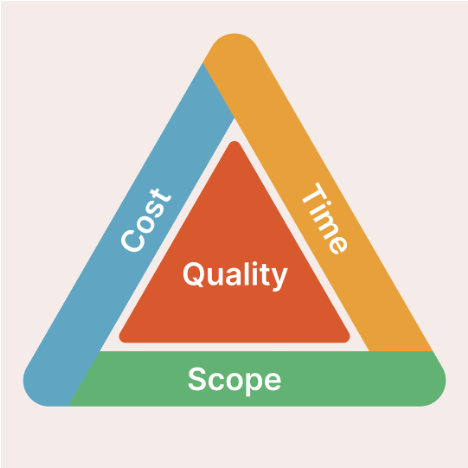
The first process group in project management is the Initiation process, which combines the project manager triangle (Scope, Time, and Cost).
- Scope: Focuses on job type, positioning your skills where they can be transferable, such as consulting, coding, and medical writing. Additionally, the flexibility to relocate can open a variety of job positions
- Time: Sets attention to milestones to stay on track. Events such as your graduation deadline will set the pace. If you have limited time, Chan and Dr. Moloye-Olabisi suggest focusing on high-impact tasks first.
- Cost and Resources: Provides a threshold for the Time, Energy and Network resources required to achieve your goal. It is essential to identify your stakeholders early in the initiation phase; for example, in a career search, the stakeholders could be yourself (the most important stakeholder in this project), your advisor, possible mentors, career coaches, and industry contacts.
Planning
The first step in planning is identifying the resources available. For the job search, your resources should focus on what will help you achieve the target job.
- Utilize AI tools to such as ChatGPT and Gemini:
- help tailor your resume to a specific job description
- help you understand salary benchmarking
- negotiate your salary after receiving the offer letter
- Use professional help and networking platforms:
- LinkedIn, can help you find job openings and network. Therefore, it is essential to keep a current LinkedIn profile and to follow alum outreach
- Career centers can help with resume reviews, mock interviews, and industry connections
- Review company websites and use project management platforms
- Microsoft Project (Planner / to-do), Trello, Asana, Monday, Notion, Airtable, and Clickup, can keep track of your job search as a project and help you track applications, deadlines, and networking activities efficiently
Another step on planning is to identify what you already have and understand what you need to acquire to finish the project. While completing a PhD, you acquire diverse skills that are highly transferable to various professional roles. It is vital to translate these skills into the language of business.
This table provides a few examples for translating common PhD skills to the industry setting:
|
PhD Skillset |
Industry translation |
|
Experience with data analysis, programming (Python, R, MATLAB), and statistics |
Product testing, data analytics, and software usage |
|
Work on literature reviews |
Regulatory affairs, strategy development, and business planning |
|
Lab management experience |
Operations management, quality control, and logistics |
|
Teaching or mentoring skills |
Communications and cross-team leadership |
Ultimately, your goal is to create a compelling narrative that clearly resonates with your skills and the job requirements. This should be impactful and immediately understandable to a variety of audiences, including recruiters and hiring managers.
The next step in the planning process is creating a schedule. This should include space for exploring opportunities, narrowing down opportunities, building resumes/CVs for each field of interest, the job search, interviews and closing with a job offer.
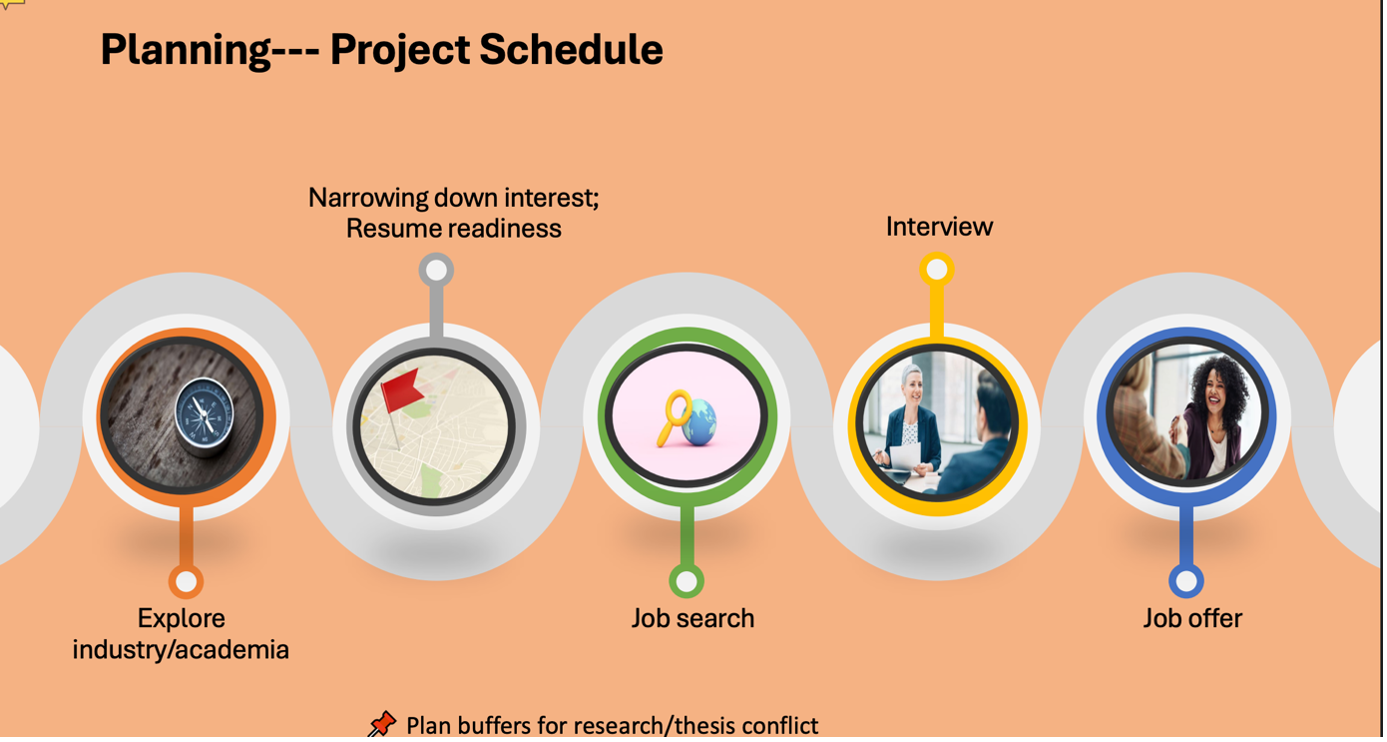
Dr. Moloye-Olabisi and Chan used strategies such as Gantt Charts and Kanban to show that it is possible to work on your thesis while actively looking for job positions. They explained how this can be done by visualizing which steps can be executed in parallel with thesis work.
Executing
The first step on the execution side is to identify the risks and find strategies to mitigate them. The set of risks while searching for job positions could be
- Time Constrains: Which can be mitigated by scheduling a dedicated weekly sprints for job search
- Thesis delay: Which time could be used to front-load networking and resume preparations
- Burnout: Which can happen when you don’t set realistic weekly goals including rest and celebration of wins, big or small
- Rejection and Application Silence: Use rejection to reevaluate your resume and portfolio
- Academic mismatch: Highlight transferable skills
- Compensation uncertainty: Research and benchmark as early as possible.
Dr. Moloye-Olabisi and Chan addressed the execution phase with two case studies. While Dr. Moloye-Olabisi explored a case study focus on “Large Company Mindset,” Chan focused on a case study of “What to Expect in a Small Company.”
Large Company Mindset
Dr. Moloye-Olabisi detailed her strategic career transition from a technical role to a business-focused position within Johnson & Johnson (J&J). She emphasized that the willingness to take risks, embrace discomfort, and continuously acquire new skills were crucial elements of this change.
Dr. Moloye-Olabisi discussed J&J's work style and environment, highlighting that it is fundamentally centered on the patient as the primary stakeholder. This patient-first approach drives the company's core focus areas, which include quality and cost, addressing diverse disease areas, unmet needs, and employee learning and health. The J&J environment, particularly within the supply chain, is characterized by its fast pace. Dr. Moloye-Olabisi attributes her success in such a large corporation to several key qualities: maintaining an open mind and a strong willingness to learn, focusing on the big picture, and making a concerted effort to understand all internal processes, from R&D through to production. The major tips shared by Dr. Moloye-Olabisi was to not be afraid to take risks, celebrate your wins big or small, network and seek mentors.
What to Expect in a Small Company
Chan next highlighted her extensive experience within a small company environment. When she initially joined Applechem as a product development scientist, the organization was comprised of only ten employees, and she was the sole medicinal chemist. Because the company lacked dedicated personnel for engineering, supply chain, and marketing, she quickly learned to wear many hats.
This necessity led her to acquire expertise across diverse fields, including early- and late-stage R&D, scale-up supply chain, regulatory affairs, quality and control, product strategy, and marketing. Furthermore, she noted that resource constraints often required her to find creative solutions to machinery shortages. Chan highlighted that demonstrating agility and taking ownership in a fast-paced, Agile environment, such as a startup, is crucial for securing necessary funding. She also shared tips of how to balance work-life and personal life as she applies the same project manager philosophy to her personal life by trying to predict risk and find solutions to mitigate them as well as setting boundaries and have a dedicate time on her day to decompress and be with her family. Chan concluded the case study by emphasizing the mindset and skills necessary to thrive in a small-company environment, such as being proactive and adaptable, focusing on outcomes, communicating clearly and often, prioritizing and simplifying processes, taking ownership, embracing ambiguity, fostering trust, and celebrating wins.
Monitoring Controlling
Monitoring progress should be scheduled weekly or monthly, depending on the specific job search goals. This process involves a systematic review to identify what is working in your overall job search strategy, particularly concerning job applications and interviews. You must use feedback gathered from informational interviews and formal interviews to fine-tune your goals and professional assets and actively identify any skill gaps you discover during the application process. Furthermore, you need to assess the traction you are gaining within your preferred industry and determine the best ways to improve your storytelling and professional narrative.
Closing
Ideally, you will secure a job offer by the closing step. To get there, you must internalize these key takeaways:
- Treat your job search like a real project
- Be your own project manager
- Apply your research Mindset in this new arena,
- Network with intention and always follow up
- Observe, adapt, and continually refine your approach.
“You are not just job hunting; You are career building!”
I appreciated the seminar greatly. It provided the critical perspective needed to understand job hunting in the context of a controlled project management process. I am committed to leveraging these powerful concepts in my current job search and ongoing career development efforts.
This article was edited by Junior Editor Joshua Stuckey and Senior Editor Joycelyn Radeny.