Let’s Get it Started: How to Write an Introduction

  • December 3, 2015
iJOBS Blog

Cartoonshutterstock_98944817-340x291 By Fatu Badiane Markey For those of you who recently read my post on how to write a results section, we will

Career satisfaction: finding the balance point among strengths, joys and values

  • December 1, 2015
iJOBS Blog

On October 24th I attended a Career Satisfaction workshop at the “What Can You Be With a PhD?” symposium, presented by Matthias Birk. The room was fully packed, I had to squeeze together with several people and sit on the floor. Mattias Birk was a passionate and inspiring speaker. I got good laughs from his humor, but I was also enlightened by his view of career satisfaction. The experience allowed me to realize it is critical to find the balancing point among strength, joy, and value for career satisfaction. First, we need to ask ourselves and/or other people (e.g.

The road less traveled – opting out of the PhD and graduating with the MS instead

  • November 24, 2015
iJOBS Blog

We all started out in the PhD program for similar reasons – we thought it would be best for our careers, we enjoyed doing scientific research, and probably believed that science was our vocation. But what about those of us that end up in labs that don’t suit our needs, or research just doesn’t make us happy anymore? While everyone hits a rough patch in the PhD journey, it is inevitable that some of us will find ourselves downright miserable for months or years in a row.

Let’s Talk Cover Letters!

  • November 19, 2015
iJOBS Blog

Blank notepad and pencil The cover letter is a job application tradition that can make or break your chances at getting that elusive interview.  Let’s face it: cover letters aren’t fun to write; it feels awkward to write about oneself so brazenly.  There is a fine balance between flat out bragging and understating your skills, but th

Removing the blinders: Rutgers iJOBS (NIH Broadening Experiences in Scientific Training grant)

  • November 17, 2015
iJOBS Blog

  best When I entered graduate school, I had only one straight career path in front of me: get my degree, apply for a post-doc position, then a faculty position, and get on my way to becoming tenured. Honestly, I thought that was what everyone did after getting their PhD.

iJOBS Site Visit Overview: Genewiz

  • November 12, 2015
iJOBS Blog

by: Dharm Patel GENEWIZ, Inc. is a contract research organization, with headquarters in South Plainfield, NJ, that provides research services for pharmaceutical, biotechnology, clinical, academic, and government institutions worldwide. Most Rutgers researchers know Genewiz as the place to send samples for DNA sequencing.

Advice and What To Do With It (in Grad School and in Life)

  • November 10, 2015
iJOBS Blog

By: Maria Qadri “…one person’s rose-tinted view of their own idiosyncratic story does not constitute “advice,” especially not in an endeavor where we value reproducibility.” This year’s American Society for Cell Biology Early Career Life Scientist, Vladamir Denic, wrote a brief and honest essay about his journey from average high school student to a successful Principal Investigator at a name-brand university.

iJOBS Intern Interview: Kathryn Drzewiecki

  • November 5, 2015
iJOBS Blog

2015-04-17 14.54.18 By Chris Lowe Some of our iJOBS participants have been able to complete an industrial internship during their PhD studies.

First Impressions of the Brain Health Institute

  • November 3, 2015
iJOBS Blog

There is a new Rutgers institute in town – and it is called the Brain Health Institute. Their mission seems to be primarily to bring neuroscience labs across all Rutgers campuses together to share findings, exchange ideas and find collaborators. The BHI hosted a symposium on Monday, October 26 (that is to become the first of many, on an annual basis).

Don’t Get Lost in the Data - Writing a Clear and Organized Results Section

  • October 28, 2015
iJOBS Blog

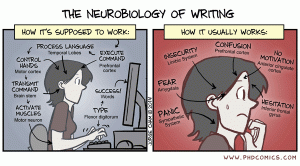
neurobiology-writers-block-phd-students By: Fatu Badiane Markey The theme of storytelling is often emphasized in the field of science. However, it is easy to forget the significance of presenting a clear and compelling story once all the experiments are complete and the hypothesis has been proven. What good are the hours spent in the lab if no one can understand the end result?