By Renata Torres da Costa

Every summer, Rutgers iJOBS runs a series of workshops and seminars focused on career development in different positions. At a recent Rutgers iJOBS workshop, a panel of faculty shared their insights into what it takes to navigate research-intensive faculty jobs, from interviewing for a position to starting a lab and earning tenure. To help demystify this path, the workshop panel featured Rutgers University faculty members, some of whom recently received tenure-track positions: Drs. Advaitha Madireddy, Morgan Firestein, Gaetan Barbet, Chloe Chung, Ipshita Zutshi, Alex Valvezan, and Kevin Monahan. Based on their experiences transitioning into independent tenure-track roles, here are some key takeaways to guide your career development strategy in an academic position.
Cracking the academic job market
Securing a tenure-track position at a research-intensive institution is one of the most significant transitions in an academic career. Running experiments at the bench and managing an independent research program requires a distinct shift in strategy, a specific mindset, and some preparation. Luckily, you can learn from the experts by following their advice and commentary on key discussion points during the seminar.
Discussion point 1: Teaching-intensive vs research-intensive academic roles
Panelist: Dr. Avaitha Madireddy
Research-intensive positions require an extensive management process, including regular grant writing, personnel management, and travel. Altogether, these activities set you further from the bench work as a scientist. A research-intensive career is a great fit for people who enjoy formulating questions and mentoring students. While research-intensive positions are focused on securing extramural grants and running an independent laboratory, teaching-intensive positions prioritize pedagogical excellence, curriculum design, and student mentorship.
To determine which role you are best suited for, Dr. Madireddy suggested starting your career evaluation early by asking yourself these questions during your training:
- Which part of my day energizes me? Running experiments or mentoring students?
- Do I want to do science for myself or run an organization that does that for me?
Discussion point 2: Selecting a postdoc to launch your independent career
Panelists: Dr. Janet Alder, Dr. Kevin Monahan, and Dr. Morgan Firestein
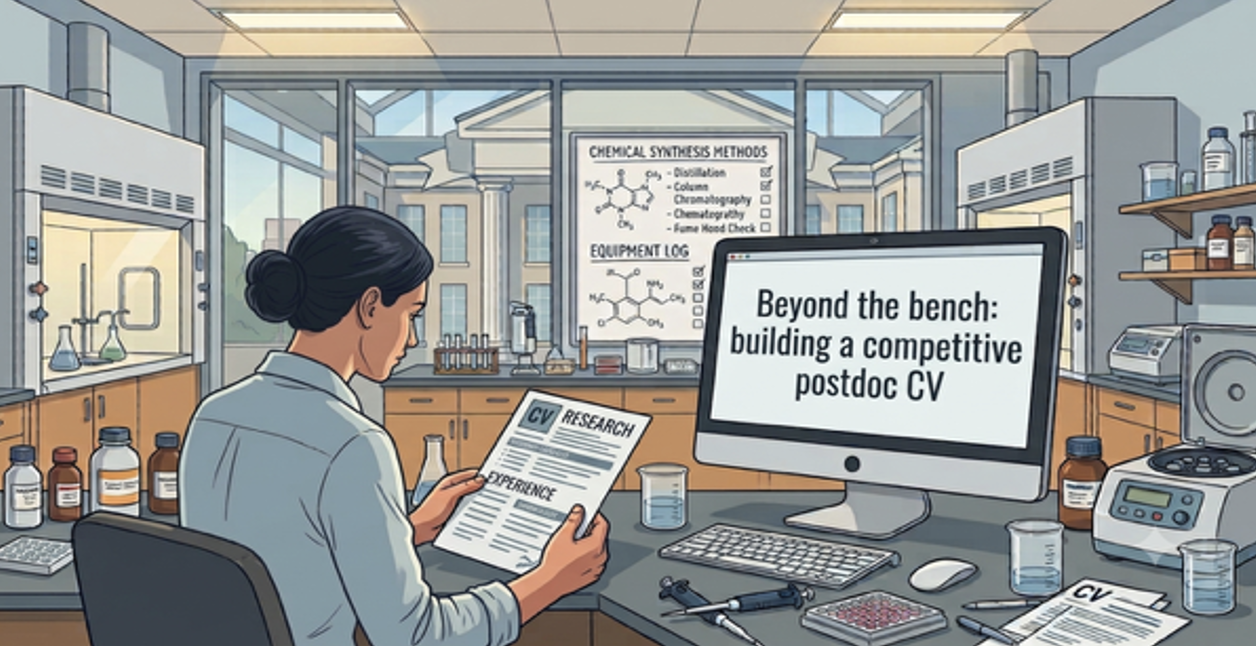
Your postdoc is not simply an extension of your PhD; it’s the launchpad for your independent research identity. When choosing a postdoc lab, consider your PhD strengths and identify new, complementary techniques that you want to acquire in the new lab. More skills will help you build an independent research program in a future position.
Notably, once you are in the postdoc path, it’s important to continually evaluate what excites you, identify a scientific gap in your field, and maintain open communication with your mentor about which projects and directions you should take to eventually launch an independent research program. In this phase, communication is key. Your success is their success, and a good mentor will help in this process.
Discussion point 3: Building a competitive postdoc CV beyond the bench
Panelist: Dr. Avaitha Madireddy
During a postdoc, your training should focus on more than bench skills. Ideal timelines for postdocs should be around one to three years. This training time should include securing independent fellowships early (e.g., the NIH K99/R00 Pathway to Independence Award), shaping your mentoring and teaching skills by supervising rotation students, and giving guest lectures to bolster your teaching statement when applying for faculty positions. In addition, you need to become “visible” in your field, seek out talks, review manuscripts, join scientific societies, and collaborate. Most importantly, you will need to cultivate a good relationship with your PI to secure a recommendation letter for future job positions.
Discussion point 4: The K99/R00 pathway and job search timeline
Panelist: Dr. Morgan Firestein
Importantly, during your postdoc, apply for and seek to secure competitive funding to support your career transition phase. The NIH K99/R00 Pathway to Independence Award is one of these award mechanisms that provides two years of postdoctoral training (K99 phase), followed by three years of faculty research. It is one of the few awards that non-US citizens can apply for. Note that the submission-to-award timeline can take up to two years, so start early during your postdoc training. The transition phase (R00 phase) is contingent upon securing a tenure-track position.
During the application for research-intensive positions, some helpful job-search strategies include searching job boards (Science Careers, Neurojobs, NYAS, institutional sites) and contacting department chairs directly. The recommended timeline at this stage is to start looking for positions in early fall, apply in late fall/early winter, and interview in late winter/spring. Expect to receive offers by late spring/early summer.
Discussion point 5: Strategic networking
Panelist: Dr. Alexander Valvezan
Networking should begin long before you apply for research-intensive positions. To cultivate a strong network in academia, start by piggybacking on your mentor’s existing network, maximizing short 5-minute interactions at conferences, building an online presence, maintaining an updated personal/lab website, and actively participating in seminars/talks.
Discussion point 6: Assembling an application package and interviews
Panelists: Dr. Chloe Chung and Dr. Kevin Monahan
The panelists also discussed the main points for assembling the application package to stand out in the search committee evaluation. This package is divided into the following: research statement, job talk, chalk talk, and interview with the search committee.
Research Statement: A concise document (around three pages), organized in a way where the first page should directly answer the five main questions:
- What is the key knowledge gap in the field?
- Why is this problem important?
- Why are you the best person to answer it?
- How is your work distinct from your mentor’s?
- What model systems or tools will you use?
Interview: The search committee might contact you to schedule an interview. This first interview usually happens virtually, but eventually you are typically invited for an in-person interview at the department/university.
In prep for the interview, get to know the faculty with whom you are interviewing by reading their most recent work. Prepare questions for them to demonstrate genuine interest. This yields realistic insights into departmental culture. Note that faculty interview days are intense marathons—lasting from breakfast through dinner. So, it’s important to prioritize sleep over late-night preparation on the day before the in-person visit. After all the meetings and interview rounds, make sure to send personalized thank-you emails to everyone you met.
Job talk: This will be a formal seminar with prepared slides that the candidate will deliver to the entire department. The focus should be on your readiness to run an independent research program rather than rehashing every previous experience from your career. Importantly, highlight your major accomplishments, such as grants and papers, and explain why the institution is a natural fit for you. This seminar usually takes around 45 minutes, including a Q&A session at the end.
Chalk talk: This is an interactive meeting session with only the search committee members, where you will be asked to discuss your past accomplishments and future research with few or no slides. Typically, it lasts one hour, during which you should keep your introduction and postdoc summary up to 20 minutes, then outline three distinct future research directions that will take up to five minutes each, and finally leave the remaining time for Q&A.
Discussion point 7: Negotiating offers and setting up your lab
Panelist: Dr. Ipshita Zutshi
At this stage of the hiring process, think deeply about your needs. Do not hesitate to ask for things that will ensure your success in your future lab. The university may pressure you to respond sooner than you would like; however, buying more time for your response should be a balancing act that you handle tactfully. To start the negotiation for your new lab, have a detailed budget breakdown with exact amounts for what you expect things to cost. Importantly, during negotiation, prioritize lab space, then start-up funds, and lastly your salary. In addition, having competing offers will give you the strongest leverage for negotiation.
Of note, the first three months of setting up a lab are usually frustrating and slowly moving due to purchasing systems, infrastructure setups, and administrative tasks. However, focus on other important actions in this stage to make your transition smoother. For example, prioritize building a lab website early to increase visibility and attract talent to your new lab or search for early-career investigator grants and apply for them.
Discussion point 8: Building your team and institutional service
Panelists: Dr. Alex Valvezan and Dr. Gaetan Barbet
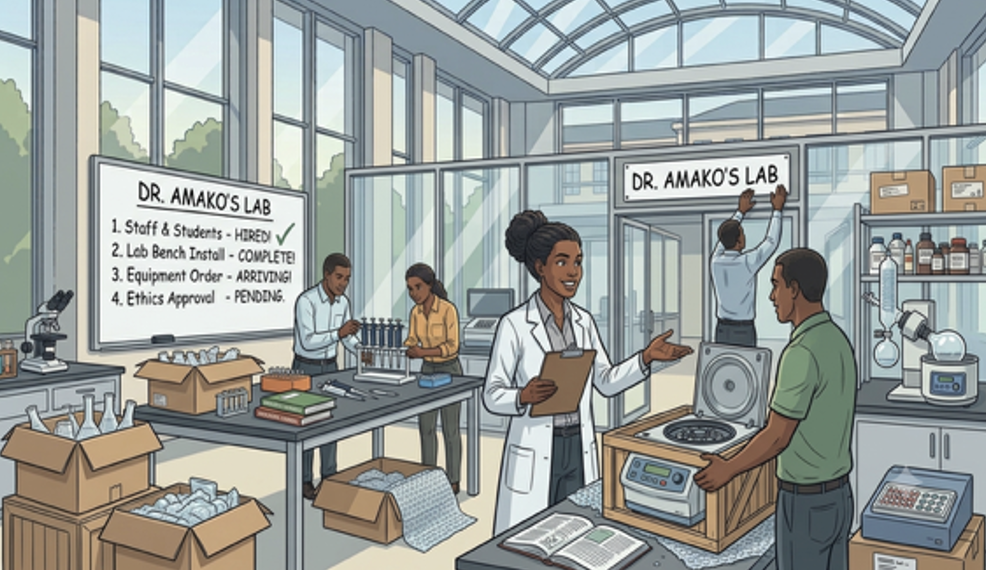
Recruiting talent: At this stage, keep in mind that you’re not just hiring individuals; you’re building a team. Use platforms to advertise opportunities at your lab, such as jobRxiv, social media, and institutional contacts, which increase visibility. In addition, once you have candidates, screen them rigorously (e.g., call references directly); an empty bench is better than hiring the wrong person.
Departmental and professional service: These services demonstrate that you are a reliable, constructive colleague, but you are starting a new lab, so don’t let administrative duties erode your lab or writing time.
Discussion point 9: Preparing for tenure
Panelist: Dr. Gaetan Barbet
The evaluation of tenure relies on three pillars:
- Research and Scholarship: (75-80%) Involves the evaluation of major grant awards (NSF, NIH), published manuscripts, and national and international reputation.
- Teaching and Mentoring: (10-15%) This is evaluated by organization/participation in classes or courses, mentorship of undergraduate/graduate students, and postdoctoral fellows.
- Services to the community: (5-10%) Include committee work, membership in core facility boards, participation in conference organization, and serving as a reviewer on grant study sections.
The planning for tenure evaluation should start during your early years as a faculty member. The sooner, the better. Many of these activities take time and networking to build.
The take-home message from this workshop is that success in the research-intensive academic track hinges on shifting your mindset from a hands-on researcher to a strategic organizational leader. The transition requires balancing high-impact science with active grantsmanship, great team building, and institutional service; all while maintaining focus on your core scientific vision. By covering and mastering these discussion points, you can position yourself to navigate the tenure-track market job with clarity, focus the initial steps to start your research lab, build a sustainable research group, and establish a lasting scientific legacy.
This article was edited by Junior Editor Joshua Stuckey and Senior Editor Antonia Kaz.